How to Light Incense Correctly: A Guide to Stillness by Monian
How to Light Incense Correctly
This guide is about one thing: using the simple act of lighting incense as a physical tool to end the day's noise and begin a state of presence.
What's Inside
This is not a spiritual text, but a functional manual. We will cover the physical technique for a perfect burn, how to confirm ignition, and the philosophy of using scent as an "Exit Mechanism."
In a life of constant input, the act of lighting incense creates a hard stop. It is a signal to the body and mind that one phase of time has ended, and a quieter one is beginning.
Yet, the ritual can be a source of frustration—a stick that won't stay lit, a scent of char instead of fragrance. This guide addresses the technical details, ensuring your experience is one of grounded ease, not another distraction.
Part 1: The Preparation
A stable environment ensures a stable burn. Before a match is struck, two things need your attention: the vessel and the air.
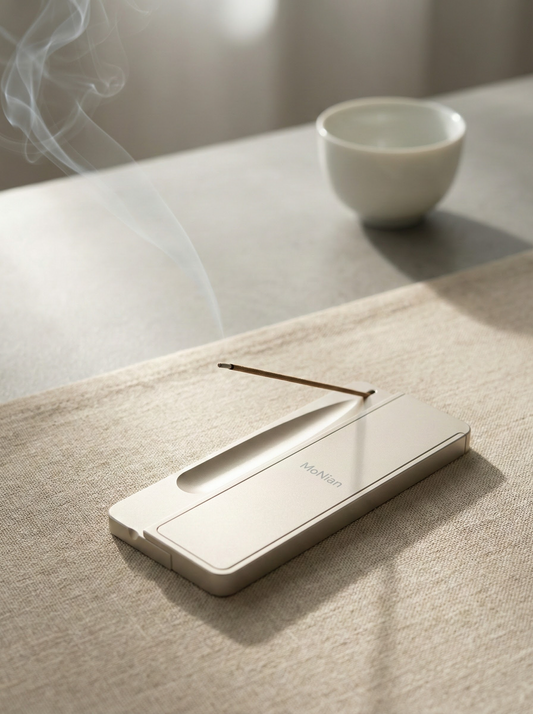
- The Vessel: Your holder must catch all falling ash. Place it on a heat-resistant surface. This preserves the cleanliness of your space, removing any underlying worry. A dedicated vessel becomes a silent, physical anchor for your ritual. Our ritual objects are designed from this principle.
- The Air: Incense needs to breathe. Never burn it in a sealed room. A slightly cracked window allows the smoke to circulate and the aroma to unfold naturally, preventing it from becoming overwhelming.
Part 2: The 5-Step Lighting Method
Patience here is everything. The goal is to create a stable, self-sustaining ember. This requires heating the core of the stick, not just scorching the surface.
- Angle the Stick. Hold the uncoated end. Tilt the tip downwards at a 45-degree angle. This uses the flame's natural tendency to rise, heating the stick more effectively.
- Ignite with Patience. Use a match or lighter. Hold the flame to the very tip for a full 10 to 15 seconds. Count it out. This is the most common point of failure. You are creating a thermal base.
- Observe the Flame. After removing your lighter, let the stick hold its own small flame for a moment (3-5 seconds). You should see the tip glowing bright orange inside the flame.
- Extinguish with a Wave. Do not blow on it. The breath is erratic. A gentle, deliberate wave of your hand is a quiet, controlled gesture that preserves the stillness you are trying to create.
- Confirm the Ember. Look closely at the tip. You should see a pulsing red ember and a thin, steady wisp of smoke. This is the sign of success.

Part 3: How to Know It's Lit
After the wave, how do you know it worked? The distinction is clear.
✔️ Correct: A Glowing Ember
The tip glows a steady, contained red. There is no flame. A continuous, thin stream of white smoke rises. This is the scent, released cleanly.
❌ Incorrect: A Black Tip
The tip is black and charred. Smoke may appear for a second, then stops. There is no red glow. The core is not lit. If this happens, simply return to Step 2 and apply the flame for longer.
Compare incense options. Follow each product’s lighting instructions.
Part 4: The Philosophy: An "Exit Mechanism"
We do not see incense as a spiritual or religious object. It is a functional tool for the mind. We call it an Exit Mechanism.
Modern work doesn't end. Thoughts and obligations bleed into personal time. The physical act of lighting the stick—the angle, the flame, the wave—creates a hard stop. It is a clear, tangible signal to your body that the "noise" is over, and "presence" can begin.
This is one part of a system for managing your state. It can be paired with the ritual of drinking tea, which serves to rebalance your inner rhythm. You do not need to try to empty your mind. Simply notice the smoke. That is enough.
A Tool for Presence
Our incense is not designed to add something to your life, but to help you return to the quiet that is already there. The Green Tea Incense, with notes of Sandalwood and Moss, is a scent for grounding.
Experience the Ritual
Tags:
Previous
A Clear End for a Noisy Day: The 15-Minute Ritual to Reclaim Your Evening
Next
Incense Burn Time Revealed: Science, History & Optimization Guide | Monian