#Incense
,
#Incense As Time Marker
,
#Incense Break
,
#incense burner
,
#Travel Incense Guide
,
#Travel Rituals
,
#Travel with Incense
,
#TSA Travel
How to avoid the $500 fine and the shame of evacuation
The 5-Foot Rule.
How to avoid the $500 fine and the shame of evacuation.
We need to talk about the fear. You know the one. You just checked into the Grand Hyatt. You are exhausted. You want to light your incense, do your 15-minute reset, and feel human again.
But you stare at the ceiling. There it is. The blinking red eye of the smoke detector. The anxiety kicks in: "If I light this, will I set off the alarm for the entire 14th floor?"
Relaxation turns into paranoia. You put the lighter away. You stay stressed.
I have traveled with incense for ten years. I have stayed in 300+ hotel rooms. I have never triggered an alarm. Not once. Because I follow physics, not luck.
⚠️ Non-Negotiable Safety Warning
Never cover a smoke detector with a sock or plastic bag. It is illegal in most countries, dangerous, and grounds for immediate eviction. Do not disable safety equipment. We work with the system, not against it.
Never cover a smoke detector with a sock or plastic bag. It is illegal in most countries, dangerous, and grounds for immediate eviction. Do not disable safety equipment. We work with the system, not against it.
1. The Physics of Dispersion
Most modern hotel sensors are photoelectric. They trigger when a specific density of particles scatters a beam of light inside the chamber. They are designed to detect billowing smoke from a mattress fire, not the thin ribbon of a single incense stick.
The danger zone is vertical concentration. If smoke rises straight up into the sensor without dispersing, you have a problem.
The 5-Foot Rule Imagine a bubble around the smoke detector with a radius of 5 feet (1.5 meters). Nothing burns inside this bubble. If the smoke has to travel 5 feet before it hits the ceiling level, it will have dispersed enough to be invisible to the sensor.
2. Draft Mapping
Air is never still in a hotel room. The AC unit is always pushing air. Before you strike a match, look at the ceiling.
You need to understand the vector. If the AC vent is pointing at your desk, and the smoke detector is behind the desk, the AC will shoot your incense smoke directly into the sensor like a laser beam. That is a rookie mistake.
The Strategy: Place your burner in the "dead air" zone—usually the bathroom vanity or the desk furthest from the HVAC intake.
3. The Pre-Burn Checklist
This takes 30 seconds. It separates the pros from the people standing in the parking lot in their bathrobes at 2 AM.
Tactical Setup
Locate the Sensor: Find it. Is it above the bed? The door?
Check Airflow: Wet your finger. Hold it up. Which way is the AC blowing?
Establish Distance: Verify you are outside the 5-foot radius.
Window Audit: If a window opens, crack it 2 inches. It creates a natural pressure release.
4. The Hardware
Hotel furniture is flammable. Hotel carpets are synthetic. You cannot use those flimsy wooden incense boats. If it tips over, you don't just have a smoke alarm problem; you have a property damage lawsuit.
You need containment. You need something that catches every micro-gram of ash.

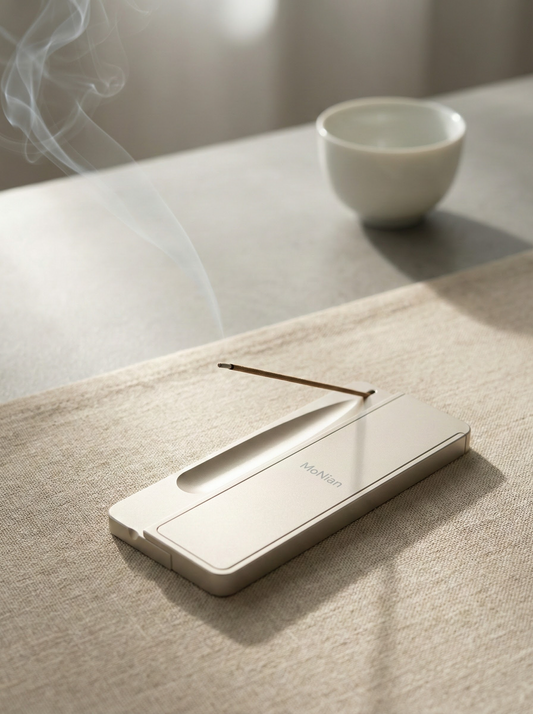
The Interface Box Machined from a solid block of aluminum. It acts as a heat sink. It has a heavy lid. If you need to extinguish immediately, you just close the box. The oxygen dies. The fire dies. View Specs
Respect the room. Respect the sensor. But don't let the fear of a beep stop you from reclaiming your space.
Tags:
Previous
The Ultimate Travel Incense Guide: Hotel Rules, Safety & Packing
Next
How to Reset a Hotel Room in 15 Minutes