How Scent Affects Your Mind: The Neuroscience of Incense and Stress
How Scent Affects Your Mind: The Neuroscience of Incense and Stress
It's not magic, it's neuroscience. This article explores the direct, non-medical pathway from your nose to your brain, explaining how scent molecules can influence your autonomic nervous system and serve as a tool for managing your mental state.
This is not a guide to self-medication. It is an exploration of the mechanics of scent. The information presented here is for educational purposes and is not a substitute for professional medical advice. The use of incense is a sensory experience, not a medical treatment.
It's 6 PM. The laptop is closed, but the day's tension remains. A low-grade hum of alertness, a residue of deadlines and digital notifications, follows you into the evening. You are physically at rest, but mentally, you are still in an open loop.
We often reach for tools to manage this state—a walk, music, a cup of tea. But one of the most direct and passive inputs into our brain's emotional hardware is the air we breathe. The human sense of smell, or olfaction, is a primal and powerful system. Unlike sight or sound, which are processed and filtered, scent takes a direct, unfiltered route to the parts of the brain that govern mood, memory, and stress.
This article will examine the science behind this connection. We will look at how specific aromatic compounds travel from the air to your brain's limbic system, how they can influence your autonomic nervous system, and how this knowledge can be used—not to magically erase stress, but to create a deliberate, sensory boundary that helps mark the end of a mental state.
The Brain's Direct Line: The Olfactory Pathway
When you inhale a scent, you are taking in volatile molecules released by a substance, such as a burning incense stick. These molecules travel to the olfactory epithelium, a small patch of tissue high inside the nose. Here, they bind to olfactory receptor neurons.
What happens next is unique among our senses. While all other sensory information (sight, sound, touch) is first routed to the thalamus—the brain's central switchboard—for processing, olfactory signals bypass this step. Instead, they travel directly to the olfactory bulb, which has a privileged connection to the limbic system.[1]

"Odors take a direct route to the limbic system, including the amygdala and the hippocampus, the regions related to emotion and memory. The olfactory signals very quickly get to the limbic system."
— Venkatesh Murthy, Professor of Molecular and Cellular Biology, Harvard University [1]This direct link explains why a scent can trigger such a powerful and immediate emotional or memory-based response. The limbic system is the brain's primitive emotional center, responsible for processing core emotions like fear and pleasure (amygdala), forming and retrieving memories (hippocampus), and regulating the autonomic nervous system (hypothalamus), which controls involuntary functions like heart rate, breathing, and the stress response.
Because of this unique neural architecture, scent is not just perceived; it is felt. It acts as a chemical message delivered straight to the brain's emotional and regulatory control centers.
Scent's Influence on the Autonomic Nervous System
The autonomic nervous system (ANS) is the background operator of our physiology. It has two main branches. The sympathetic nervous system (SNS) is the "fight-or-flight" system. It prepares the body for action, increasing heart rate, blood pressure, and alertness. Chronic stress keeps this system in overdrive. The parasympathetic nervous system (PNS) is the "rest-and-digest" system. It promotes calm, lowers heart rate, and aids in recovery. Activating this system is key to mitigating stress.
Recent research shows that olfactory stimulation can directly influence the balance between these two systems. A 2024 study published in Scientific Reports found that aromatherapy can enhance parasympathetic nervous activity (PNA).[2] The study measured heart rate variability (HRV), a key indicator of ANS balance. Higher HRV is associated with better health and a stronger parasympathetic response.
The researchers observed that under aromatic conditions, participants showed an accelerated recovery of HRV after exercise, indicating that the scent helped shift their nervous system toward a state of rest more quickly.[2] This effect is not merely psychological. It is a measurable physiological shift. Certain aromatic compounds, once they cross the blood-brain barrier, can interact with receptors in the central nervous system, modulating its activity.[3]
The Cortisol Connection
Cortisol is the body's primary stress hormone. While essential in small doses, chronically elevated levels contribute to anxiety and other health issues. Studies have shown that inhaling specific scents can lead to a measurable reduction in cortisol levels.
A 2016 study published in the Iranian Journal of Nursing and Midwifery Research investigated the effect of lavender essence inhalation on patients awaiting open-heart surgery. The results were significant: the study found that 69.6% of the decrease in blood cortisol was attributable to the inhalation of lavender.[4] This provides strong evidence that scent can have a direct biochemical effect on the body's stress response.
Scents and Their Studied Effects
While scent experience is subjective, research has identified common physiological responses to certain aromatic compounds.
| Scent Family | Primary Compound(s) | Studied Effects on the Nervous System |
|---|---|---|
| Lavender | Linalool, Linalyl Acetate | Associated with increased parasympathetic activity, reduced cortisol, and decreased self-reported anxiety.[4] Often described as calming. |
| Sandalwood | α-Santalol, β-Santalol | Studies suggest it can induce a state of relaxation while maintaining alertness. Often used to ground and focus the mind. |
| Cedarwood | Cedrol, α-Pinene | Research indicates α-pinene can significantly increase parasympathetic nervous activity.[5] Often described as grounding and stabilizing. |
It is important to note that personal preference plays a role. The 2024 Scientific Reports study found a positive correlation between a person's preference for a scent and the strength of the parasympathetic response.[2] If you find a scent unpleasant, it is unlikely to be relaxing for you, regardless of its chemical properties.
Using Scent as an Intentional Tool
Understanding the neuroscience of smell allows us to use it as more than just a background fragrance. It can become an intentional tool for creating transitions and managing our mental state.
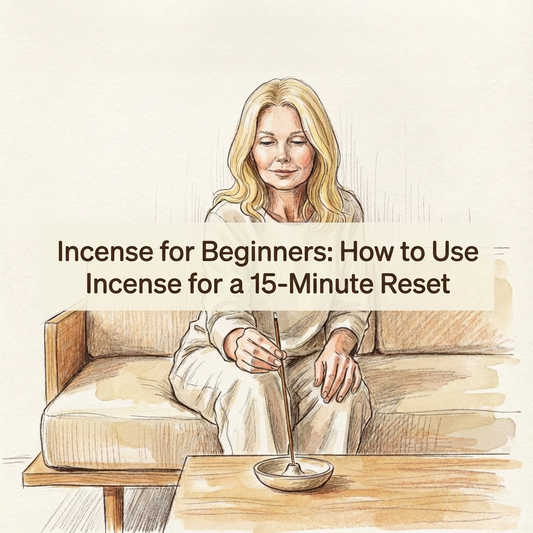
This is not about "curing" anxiety with a scent. It is about using a sensory anchor to signal a shift in your nervous system. Consider the practice detailed in our guide, The Deep Work Stick. The act of lighting an incense stick, such as our Devdar Incense with its grounding cedarwood notes, is a physical cue.
As the scent fills the space, it provides a constant, passive input to your limbic system. By pairing this sensory input with a simple breathing exercise, you can amplify the shift toward a parasympathetic state:
Box Breathing with Incense
- Light the incense. Place it in a safe holder and allow the scent to begin filling the space.
- Inhale slowly for a count of four as you watch the smoke rise.
- Hold your breath for a count of four.
- Exhale slowly for a count of four.
- Pause for a count of four. Repeat the cycle for 1-2 minutes.
This combination is effective because it works on two levels: the scent provides a direct, bottom-up input to your brain's emotional centers, while the controlled breathing provides a top-down signal to the autonomic nervous system that it is safe to relax.
Continue Reading
- Explore Our Incense Collection — Find a scent that resonates with you.
- Incense Guide — Learn more about using scent intentionally.
- The Deep Work Stick — Using incense as an analog timer for focus.
A Sensory Tool for Transitions
The Devdar Incense features grounding Himalayan cedarwood notes. Each stick burns for approximately 30 minutes, providing a consistent sensory anchor for your practice.
View Devdar IncenseFrequently Asked Questions
Is this just a placebo effect?
While the psychological expectation of relaxation (placebo) plays a role in any ritual, the effects of scent are not purely placebo. As studies on heart rate variability (HRV) and cortisol levels show, inhaling certain aromatic compounds produces measurable physiological changes in the autonomic nervous system and endocrine system.[2] [4]
Will incense cure my anxiety?
No. Incense is not a medical treatment and should not be used as a substitute for professional mental health care. It is a sensory tool that can help manage momentary feelings of stress and facilitate a transition into a more relaxed state. Think of it as one tool among many in a broader mental wellness toolkit.
How long does it take to feel an effect?
Because the olfactory pathway is so direct, the brain's response to scent is nearly instantaneous. Physiological changes, such as a shift in brainwave activity or heart rate, can occur within seconds of inhalation.[3]
How does scent reach the brain so quickly?
Unlike other senses that are first routed to the thalamus for processing, olfactory signals travel directly to the olfactory bulb, which has a privileged connection to the limbic system—the brain's emotional center. This direct pathway explains why scent can trigger such immediate emotional responses.[1]
References
- Walsh, C. (2020). How scent, emotion, and memory are intertwined. The Harvard Gazette. https://news.harvard.edu/gazette/story/2020/02/how-scent-emotion-and-memory-are-intertwined-and-exploited/
- Okada, K., & Shimatani, K. (2024). Effect of olfactory stimulation from aromatherapy on the autonomic nervous activity during aerobic exercises. Scientific Reports, 14(1), 11198. https://www.nature.com/articles/s41598-024-61732-w
- Sowndhararajan, K., & Kim, S. (2016). Influence of Fragrances on Human Psychophysiological Activity. Scientia Pharmaceutica, 84(4), 724-752. https://pmc.ncbi.nlm.nih.gov/articles/PMC5198031/
- Hosseini, S. A., et al. (2016). Effect of lavender essence inhalation on the level of anxiety and blood cortisol. Iranian Journal of Nursing and Midwifery Research, 21(4), 397–401. https://pmc.ncbi.nlm.nih.gov/articles/PMC4979264/
- Ikei, H., Song, C., & Miyazaki, Y. (2016). Effects of olfactory stimulation by α-pinene on autonomic nervous activity. Journal of Wood Science, 62(6), 568-572. https://link.springer.com/article/10.1007/s10086-016-1576-1
Tags:
Previous
Incense for Beginners: How to Use Incense for a 15-Minute Reset
Next
Incense and Candle: The Architecture of Stillness